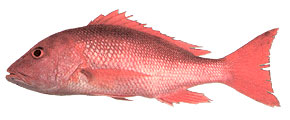
Red
snappers are an overall rosy-red color. The color fades
slightly below. Key characteristics are their red eye,
the anal
fin being pointed rather than rounded, and the lack of
a black
spot on each side in individuals over 10 inches long.
Red
snappers spawn over 20 times a year at 4 to 6 day intervals
between late May and early October, with a peak in June-August.
Some red snapper mature at under one foot in length and
they continue to spawn for the rest of their lives. Small
fish will produce less than 500 eggs per spawn and large
fish over 2 million eggs. Red snappers spawn in early
evening. Their eggs and larvae are free-floating and at
the mercy of currents.
Red snappers are often thought of territorial fish that
do not
move much as adults. Recent research has shown that red
snappers may move around more than commonly thought. In
the late 1990s, researchers caught, tagged, and released
almost three thousand red snappers in the northern Gulf.
Almost
19% of these tagged fish were recaptured. Only about 26%
of the
fish tagged were in the same place one year later. The
average tagged fish moved 18.6 miles before recapture.
Tagged red snappers were found to move further and faster
than ordinary when hurricanes affected an area. The longest
distance moved was 219 miles.
Red snappers are considered reef fish, so it would be
logical to
assume that they eat smaller creatures from the reefs.
Interestingly, most of their diet has been found to consist
of creatures that live on mud bottoms, so red snappers
get very little nutritional benefit from reefs. Fish are
the number one item in their diet, with the most common
ones being pipefish, snake eels, searobins, pinfish, striped
anchovies, cusk eels, and pigfish.
Stomatopods (king shrimp or sea lice) are the second most
important food item, followed by several species of crabs.
Also eaten are tiny pinhead-size zooplankton and bottom
worms. Shrimp make up only a very small portion of their
diet.
Food habits change by season. Fish are always important,
but
crabs are the most common food item in spring and stomatopods
are most important in the winter. A lot of stomatopods
are also eaten in the summer, but almost none in the spring
or fall. Diet also changes with fish size. As red snappers
grow larger, they eat more fish. Also, the largest snappers,
those 24 inches long and longer, eat far more stomatopods.
Red snappers also have daily feeding patterns. One study
showed that they had empty stomachs from 7:00 p.m. until
3:00 a.m. It seemed that the fish then began feeding heavily,
reaching a peak at 4:00 a.m., but continued heavy feeding
until 6:00 a.m.
Red snappers are a heavily regulated species with a relatively
large minimum size. Undersized fish must be released,
often to the distress of fishermen. Many of the red snapper
caught, especially from deeper waters, have their stomachs
protruding from their mouths, forced there by the expansion
of gases in the air bladder as the fish are brought to
the surface. Most fishermen assume that all of the fish
released in such condition will die. Research indicates
that, unless another bigger fish eats them first, that
70-80% of these fish will recover and survive. Only one
thing will cause 100% of them to die - well intended fishermen
poking a hole in the stomach with a knife or other sharp
object to "help the fish swim down."